From Aagrah’s collection
Try a shorter fastening loop if the bracelet has one designed for that purpose. Then move your wrist normally and check that it stays on without pressing. If no setting fits, ask about resizing or an exchange. If the clasp opens by itself, stop wearing it—a shorter bracelet will not fix a faulty fastening.
See what happens during ordinary movement
Try the bracelet over a table or another surface where you can easily retrieve it. Lower your hand, turn your wrist and rest it as you would while typing. Use normal movements rather than shaking it to test the fit.
Notice the specific problem. Does the whole bracelet travel too far? Does an extender catch your sleeve? Or does the clasp open even though the length feels right? Each needs a different response.
| What you notice | What to do next |
|---|---|
| It drapes, stays on and doesn't bother you | Keep that setting if you like the fit. |
| It moves across the hand or can slip off | Try a shorter intended setting; if none works, ask about sizing or alteration. |
| The loose end keeps catching | Ask whether the design has a shorter wearing option or whether a jeweller can shorten the end. |
| The clasp opens by itself or won't close fully | Stop wearing it and have the fastening assessed. Shortening won't solve this. |
On a small screen, swipe the table sideways to see every column.
Try the bracelet over a table or another surface where you can easily retrieve it.
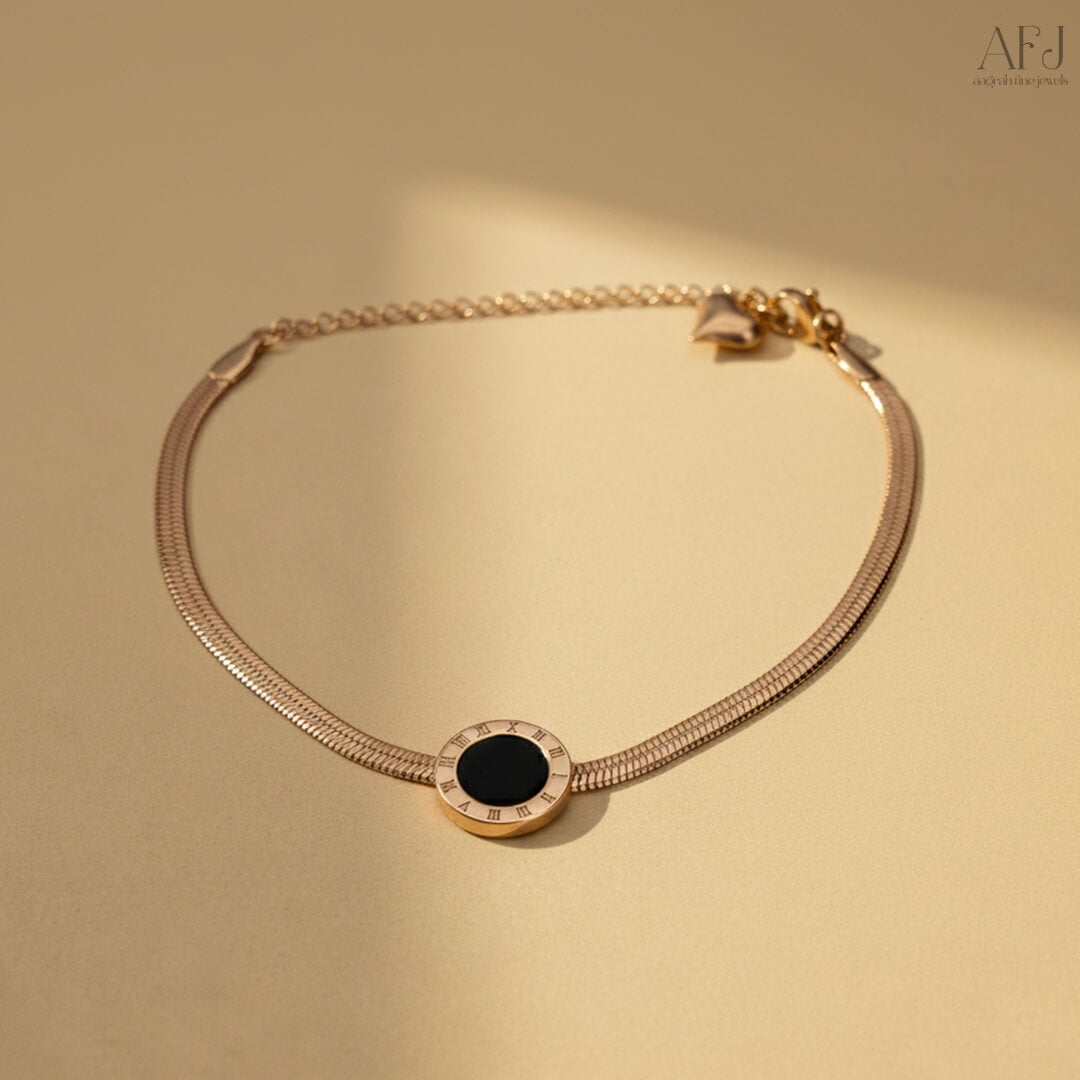
A chain bracelet may have extender loops intended for the clasp.
A jeweller can examine the construction and tell you whether it can be shortened neatly.
Use only the adjustment the design provides
A chain bracelet may have extender loops intended for the clasp. Move to one of those, fasten it fully and repeat the ordinary-movement check. A decorative link elsewhere in the bracelet isn't necessarily a fastening point.
For a sliding closure, follow the maker's directions. If the mechanism won't move as described, stop pulling and ask for a demonstration using the exact model.
A rigid cuff is different again. An opening does not tell you whether the metal is designed to bend. Find the instructions before attempting to squeeze it smaller.
Decide whether shortening is worth discussing
A jeweller can examine the construction and tell you whether it can be shortened neatly. Bring the bracelet and explain where you'd like it to sit. Ask what the alteration would involve and what it would cost before agreeing.
For a plated piece, mention the finish as well as the base material if known. For a bracelet with stones or decorative links, point out the section you'd like to keep centred. Those details help the jeweller assess the actual piece rather than give a general answer by phone.
Leave cutting, removing links and refitting the clasp to someone who can assess the construction. A knot in a fine chain may make it shorter, but it also changes how the chain sits and can be difficult to undo.
When it fits but still gets in the way
A bracelet can fit correctly and still feel awkward beside a watch or under a close sleeve. Try it on the other wrist or with a different sleeve before deciding that its length is wrong.
For example, if you enjoy wearing it to dinner but keep moving it while using your laptop, you may simply prefer wearing it outside work. Adding another bracelet as a barrier won't correct a piece that actually slips off.
Take the measurement before choosing another size
Follow the wrist-measuring steps, then compare them with the instructions for that design. Keep a note of the setting that felt too loose, not just the size printed on the label.
Start by identifying the problem in one sentence: “The clasp stays closed, but the bracelet slides over my hand,” or “The length feels right, but the clasp opens.” The seller or jeweller can then focus on the length or the fastening instead of guessing which part bothers you.