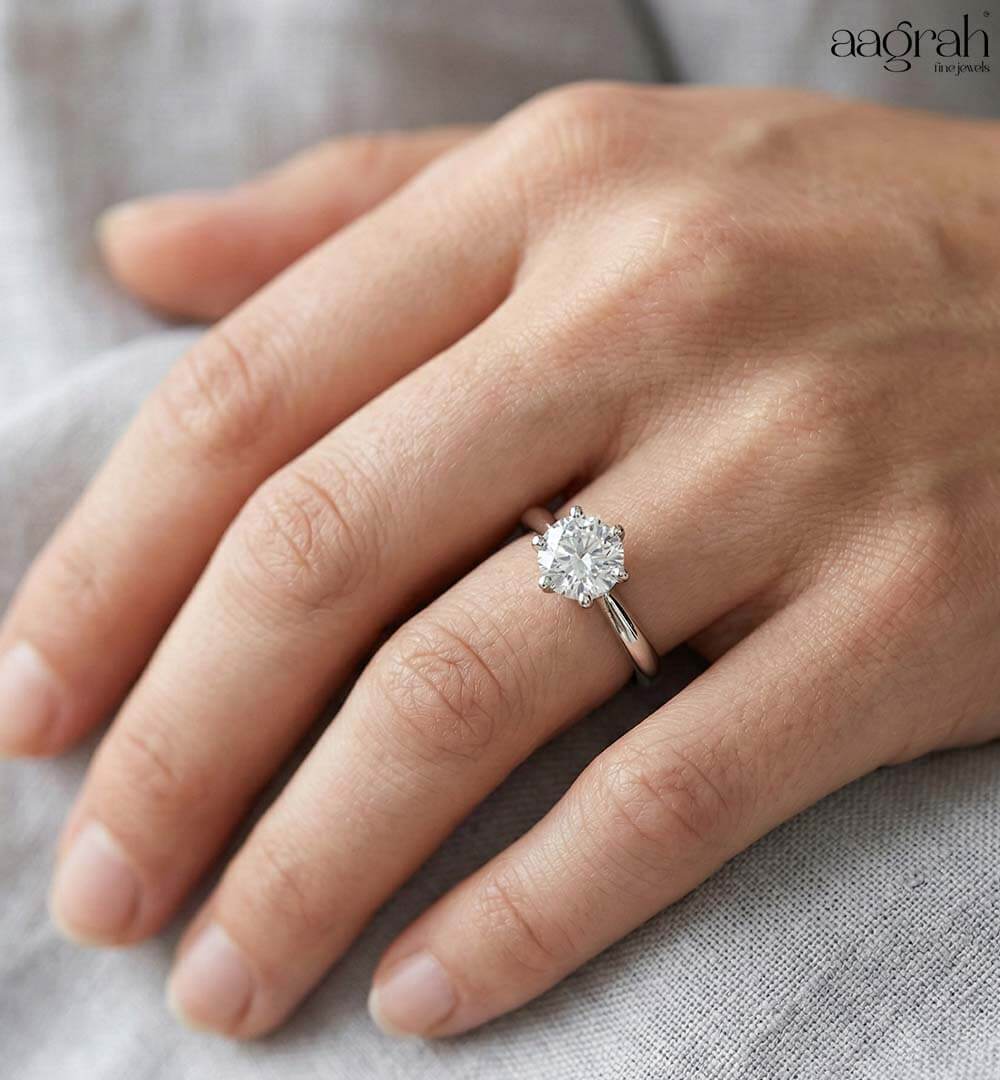
From Aagrah’s collection
For a surprise ring, the best clues are a recent size she has shared, a close friend who has shopped for rings with her, or a ring that fits the same finger. If you can use that ring, measure its inner diameter. Keep the hand, finger and sizing system with the number. If none of those clues is reliable, keep the design a surprise and check the fit together.
Start with something she has already told you
Perhaps she tried on a ring while you were shopping together or sent you a link to one she liked. Look for the details she shared: the seller, size, intended finger and hand. A saved product link only helps with size if she actually told you which option fits.
For example, “US size 7 on her right ring finger, from a recent fitting” is much clearer than “I think she said seven.” If the information is old or the new ring is much wider than the one she tried, use it as a starting point and ask about the fit of the new design.
When she mentions a size casually, you can ask a small follow-up without revealing the whole gift: “Is that the finger you usually wear rings on?” The exact piece, card and occasion can remain yours to plan.
Diameter goes straight across the centre. Leave the metal band out of the reading.
Diagram only — not an on-screen size guide.Ask one person who may actually know
A sister or close friend who has recently shopped for rings with her may be able to help. Ask for information they already have:
I'm thinking of a ring for her birthday. Do you happen to know the size she uses and which finger it fits? If you have the brand or a link from when you shopped together, that would help.
If the answer is “probably a 6 or 7”, the size is still uncertain. Ask whether they remember the shop or have the original product link. If they don't, you can still ask about the designs she likes and leave the fitting for later.
Measure a ring she wears on the intended finger
Use a ring she is comfortable with you handling and that fits the intended finger. Measure across the empty inside opening, excluding the metal. Our existing-ring measurement guide shows the ruler position and how to record the result.
Before relying on it, ask yourself:
- Do I know which hand and finger she wears this ring on?
- Does it currently fit her comfortably?
- Is the opening round and easy to measure?
- Can I measure it without taking away something she will look for or worry about?
If you usually handle each other's accessories, measuring together while looking at jewellery may feel natural. If you would have to hide or remove a ring she values, use another route. The surprise is easier to enjoy when she hasn't spent the afternoon searching for a missing ring.
Which clues won't give you a dependable size?
Her height, clothing size and the size of your own hands don't provide the measurement of the finger she will use. A ring worn on a different finger also leaves the important question unanswered.
A photograph may show the design she likes, but an ordinary phone image doesn't give a reliable physical scale. Tracing a ring adds another possible error from the pencil line. For an order, aim for an actual measurement or a known fitting rather than trying to improve a visual guess.
If someone offers a “most common women's size”, remember what it tells you: a general suggestion, with no measurement of your girlfriend's finger. It is not enough to confirm this purchase.
Make a quick decision before ordering
| What you know | What to do next |
|---|---|
| Recent size, named system, exact hand and finger | Compare it with the chosen seller's chart and the ring's fit guidance |
| A round, well-fitting ring for that finger | Measure the inside diameter or have it measured |
| A helper remembers a number but not the system | Ask for the brand or original product information; keep it unconfirmed until then |
| Only a rough guess or a ring from another finger | Choose the fit with her before ordering |
On a small screen, swipe the table sideways to see every column.
If a reliable size is in another system, compare Indian and US sizes using millimetres. Keep the original label as well as the conversion.
What about an adjustable ring?
It still needs a suitable fit range. “Adjustable” doesn't tell you whether the design can reach her size, and an open band may not be adjustable at all. Get the maker's stated range and method before relying on that feature. Our adjustable-ring guide explains the distinction.
If you know she likes the design but cannot establish the size, save the ring to a shortlist. You can show it to her with a note, then order after checking the fit together:
You pointed out a ring like this when we were out, and I kept thinking it looked like something you'd choose. I wanted the design to be a surprise, but I'd like you to help me get the fit right. Shall we look at it together?
Check the size details before ordering
Before ordering, write down the hand, finger, sizing system and where the information came from. If a detail is missing, resolve that one question. And if the size is still uncertain, choose a surprise-ring plan that allows you to check the fit together. The note and the design can still show how carefully you thought about her.


