
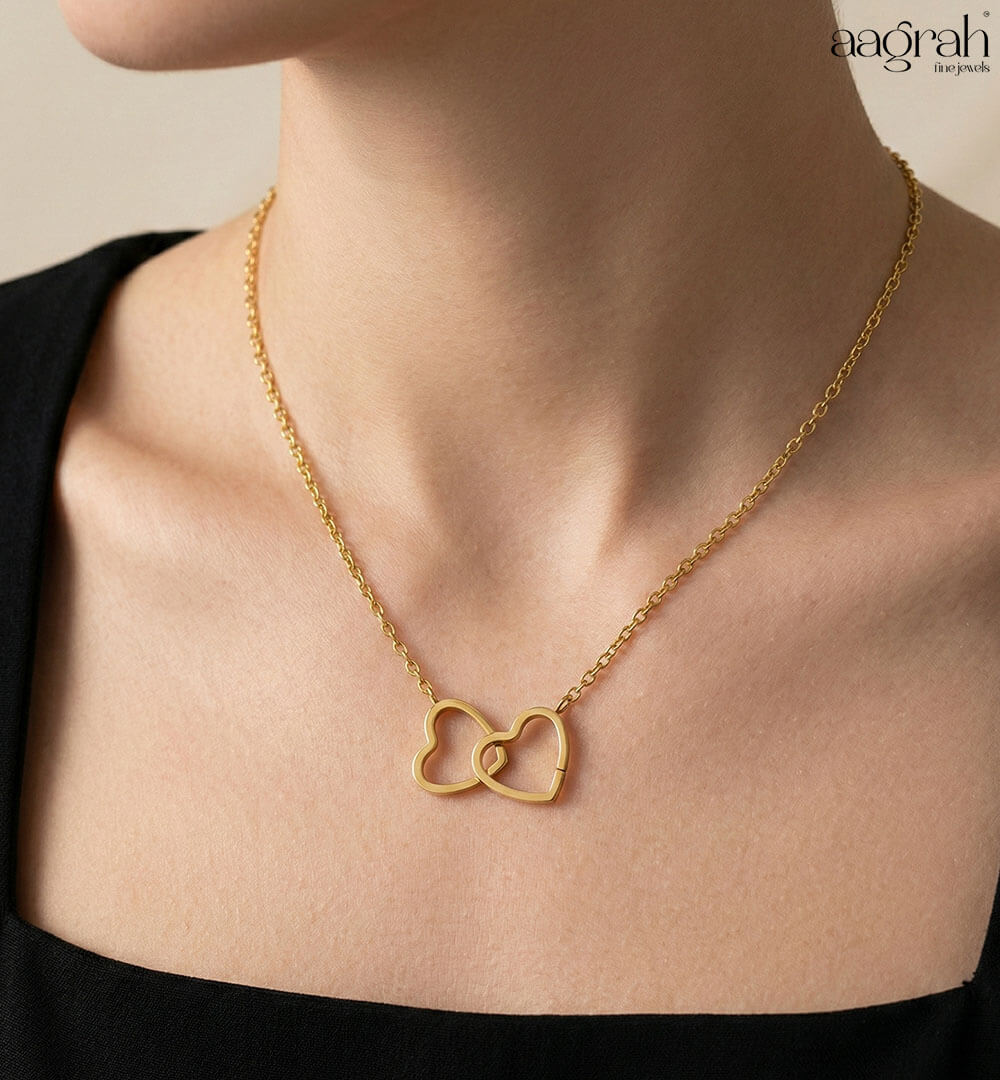
From Aagrah’s collection
Unfasten the necklace, lay it straight without pulling, and measure from the clasp to the loop you normally use. Record any extender separately. If a pendant hangs below the chain, measure its drop separately too; it is not part of the chain length.
Lay out the chain and identify the fastening points
Choose a flat surface with good light. Unfasten the clasp and gently straighten the chain. If it is knotted or kinked, deal with that before measuring; do not pull hard to make it lie straight.
Place the clasp end at the zero mark and read the measurement at the loop it normally fastens into. Include the clasp rather than measuring only the chain links. Record those two endpoints so you can ask a seller to measure a new necklace the same way.
If the necklace has a central feature fixed between two chain sections, include that feature in the necklace's path from one fastening end to the other. If a pendant hangs from the chain instead, leave its downward length out of the chain measurement.
16 in = 40.64 cm
18 in = 45.72 cm
Record the extender separately
An extender gives more than one possible fastening point. Measure the shortest usable length, the longest usable length and, if different, the point you prefer to use.
Here is an illustrative note:
“My necklace measures 40 cm at the first fastening loop and 45 cm at the last. I usually wear it at 43 cm. The pendant hangs another 2 cm below the chain.”
That is much clearer than “I wear a 45 cm necklace”, which could lead someone to choose a fixed 45 cm chain when you normally fasten yours shorter.
A listing saying “40 + 5 cm” often intends a base length plus an extender, but ask if the description is unclear. You want to know the shortest and longest wearable lengths, not a total that includes an extender you would never fasten at its end.
Measure a pendant as its own part
For a pendant, record its width and height and check whether that height includes the bail—the loop the chain passes through. When comparing where the bottom will sit, consider the full hanging drop from its attachment.
A 2 cm pendant and a 5 cm pendant will not finish at the same point on an otherwise identical chain. Our everyday pendant-size guide explains how to preview that scale.
Preview a length when you have no necklace to compare
Use a soft tape or a measured piece of non-stretch string to make a loose, easy-to-release loop at the proposed length. Hold the ends together rather than tying it around your neck. Try it with the top or kurta you want to wear.
This gives an approximate position, not the weight or drape of the finished necklace. Neck circumference, chain construction and pendant size can all change where the piece sits.
Take a front and side look, then sit down. A length that looks right standing may place a pendant against a shirt button or let it disappear inside the collar.
Use the measurement when you compare listings
Keep the base length, preferred fastening point and pendant drop together in your notes. If a listing omits one, ask for it before choosing. For a common length comparison, see 16-inch versus 18-inch necklaces.
Your final reference should describe the necklace as you wear it. “43 cm with a small pendant” is a much better starting point than guessing from the word “short”.